Article Plan: Eco Literacy Curriculum PDF
This document outlines a plan for developing a comprehensive eco-literacy curriculum, drawing from research and resources like Ecoliteracy.org and studies on soil seed banks.
Eco-literacy represents a fundamental shift in education, moving beyond traditional subject boundaries to embrace the interconnectedness of all living systems. It’s about cultivating an understanding of ecological principles and applying them to daily life, fostering responsible citizenship.
This curriculum aims to equip learners with the knowledge and skills to navigate a rapidly changing world, addressing challenges like unsustainable consumption – exemplified by the hidden costs within everyday items like jeans.
Inspired by frameworks from organizations like Ecoliteracy.org, and practical applications like the Seoul soil seed bank programs, this approach emphasizes hands-on learning and critical thinking.

Defining Ecological Literacy
Ecological literacy transcends simply knowing about the environment; it’s a deep understanding of how ecosystems function and our place within them. It involves recognizing patterns of organization, like networks, that underpin life’s fundamental interbeing, as highlighted by Daniel Christian Wahl.
This curriculum defines eco-literacy as the ability to analyze the environmental consequences of choices – from purchasing habits to broader societal structures.
It’s about connecting consumption to global issues and fostering a worldview centered on sustainability, drawing inspiration from the work of pioneers in the field and current research.
Core Principles of Eco-Literacy
Central to this curriculum are interconnectedness and interdependence, recognizing that all living systems are intricately linked. Systems thinking is paramount, moving beyond linear cause-and-effect to understand complex relationships within ecosystems.
A key principle involves acknowledging the ethical dimensions of environmental issues, linking eco-literacy to social justice.
Furthermore, the curriculum emphasizes place-based education, fostering local environmental responsibility and utilizing immediate surroundings as powerful learning tools, as advocated by various researchers.
The Importance of Systems Thinking
Systems thinking is foundational to eco-literacy, shifting perspectives from isolated parts to holistic, interconnected wholes. This approach moves beyond simplistic linear models, revealing the dynamic feedback loops inherent in natural systems.
Understanding these patterns – networks of mutual support and exchange – is crucial, mirroring life’s fundamental interbeing.
The curriculum will actively cultivate this skill, enabling students to analyze complex environmental challenges and devise sustainable solutions, recognizing ripple effects throughout ecosystems.

Historical Development of Eco-Literacy Education
The evolution of eco-literacy education has progressed from nascent articulations to formalized frameworks. Early pioneers challenged traditional, fragmented curricula, advocating for a pedagogy mirroring living systems.
Publications like “Ecological Literacy” spurred critical examination of educational models, contrasting them with unsustainable fast-food approaches.
Contemporary development builds upon this foundation, integrating empirical research – such as studies on soil seed banks – to inform effective curriculum design and implementation.
Early Articulations and Pioneers
Initial calls for ecological literacy emerged as critiques of conventional education’s disconnect from natural systems. Visionaries questioned curricula modeled after unsustainable practices, like fast-food chains, advocating for holistic learning.
“Ecological Literacy” served as a pivotal text, gathering diverse voices to propose alternative pedagogies.
These early proponents emphasized the need to move beyond rote memorization towards experiential learning, fostering a deeper understanding of interconnectedness and environmental responsibility, laying groundwork for future programs.
Evolution of Eco-Literacy Frameworks
Early frameworks focused on defining ecological literacy and its core principles, evolving from broad philosophical concepts to more structured educational approaches. Research, such as the study by Ju & Kim (2011), began empirically testing programs—like those utilizing soil seed banks—to promote eco-literacy among students.
These frameworks increasingly integrated systems thinking and place-based education, emphasizing local environments and fostering a sense of responsibility.
The evolution reflects a shift towards practical application and measurable outcomes.
Key Components of an Eco-Literacy Curriculum
A robust eco-literacy curriculum centers on interconnectedness and interdependence, fostering an understanding of ecosystems and their functions. Practical applications, like soil seed bank programs demonstrated by Ju & Kim (2011), are crucial for hands-on learning.
Critical thinking skills, informed by eco-pedagogy, are essential for connecting consumption patterns to broader global issues.
Place-based education, utilizing local environments, builds local environmental responsibility.
Interconnectedness and Interdependence
Eco-literacy fundamentally emphasizes the web of life, revealing how all living systems are intricately linked. Networks, as highlighted by Daniel Christian Wahl, represent life’s fundamental interbeing, enabling mutual support and learning within ecosystems.

Understanding these patterns of organization is vital; a purchase, like jeans, carries global implications – child labor in South Asia, for example.
This interconnectedness demands a holistic worldview.
Understanding Ecosystems
A core component of eco-literacy involves grasping the dynamics of ecosystems, moving beyond fragmented knowledge to see the whole. Practical application, such as the soil seed bank programs tested in Seoul, South Korea (Ju & Kim, 2011), provides hands-on experience.
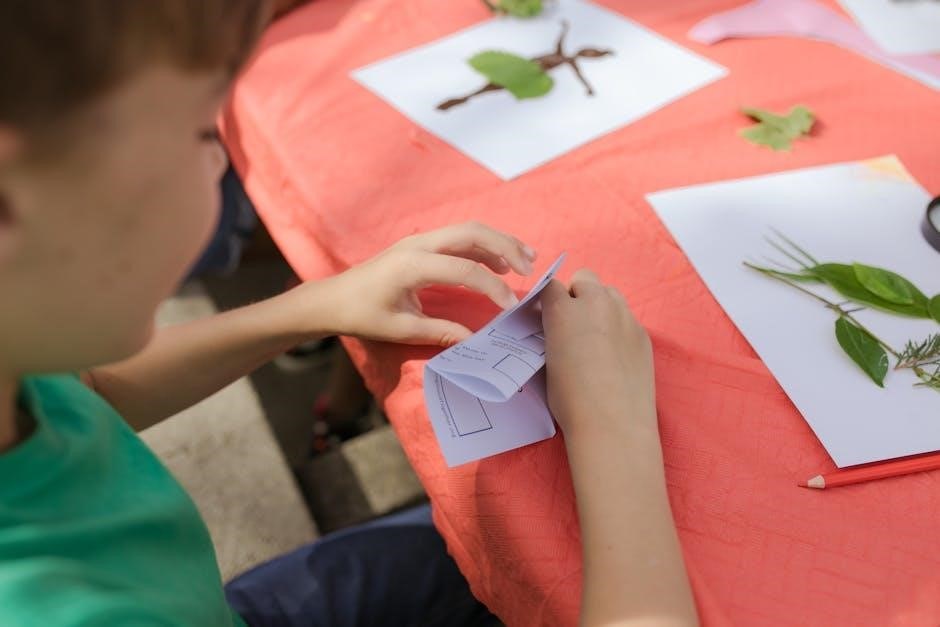
These programs – sampling, watering, observation – foster direct engagement with ecological processes.
Students learn to identify seedlings and understand growth, building a foundational understanding of natural systems.
Practical Applications: Soil Seed Bank Programs
Soil seed bank programs offer a tangible pathway to ecological literacy, as demonstrated by Ju & Kim’s (2011) research in Seoul, South Korea. Their seven-activity program—sampling, setting, watering, identifying, and observing—engaged primary school students.
This hands-on approach contrasted with traditional textbook learning, fostering a deeper understanding of lima bean seed growth.
Such programs cultivate direct experience with ecosystem processes, promoting active learning and environmental stewardship.
Case Study: Seoul, South Korea (Ju & Kim, 2011)
Ju & Kim’s (2011) study in Seoul, South Korea, provides valuable insight into eco-literacy education. Researchers implemented a soil seed bank program in two urban elementary schools, involving 99 fourth-grade students.
Two experimental groups participated in the program—sampling, planting, and observing—while a control group followed the standard curriculum.
The results demonstrated the program’s effectiveness in promoting ecological understanding among young learners, highlighting the benefits of experiential learning.
Benefits of Hands-on Activities
Experiential learning, like the Seoul soil seed bank program (Ju & Kim, 2011), significantly enhances eco-literacy. Direct engagement with natural processes fosters deeper understanding than textbook learning alone.
Activities such as sampling, planting, and observation cultivate a sense of responsibility and connection to the environment.
These practical experiences promote critical thinking and problem-solving skills, essential components of an effective eco-literacy curriculum, moving beyond abstract concepts.
Eco-Pedagogy and Critical Thinking
Eco-pedagogy extends beyond environmental awareness, encouraging students to critically examine the socio-economic systems impacting ecological health. It challenges conventional thinking and promotes a holistic worldview.
Considering the impact of consumer choices – like purchasing jeans and supporting potentially exploitative labor practices – exemplifies this critical lens.
This approach fosters responsible citizenship and empowers learners to advocate for sustainable solutions, integrating various critical pedagogies.
Connecting Consumption to Global Issues
An eco-literacy curriculum must bridge the gap between individual consumption habits and their far-reaching global consequences. Examining everyday purchases, such as a simple pair of jeans, reveals complex interconnectedness.
This seemingly innocuous item can be linked to issues like child labor in South Asia, highlighting the ethical and environmental costs embedded within supply chains.
By fostering this awareness, students develop a critical understanding of their role in a globalized world and the need for responsible consumerism.
The Role of Eco-Literacy in Social Justice
Eco-literacy extends beyond environmental concerns, deeply intertwining with principles of social justice. Recognizing that environmental degradation disproportionately impacts marginalized communities is crucial.
A robust curriculum should explore how issues like pollution, resource depletion, and climate change exacerbate existing inequalities, creating environmental racism and injustice.
Eco-pedagogy, therefore, becomes a tool for empowering students to advocate for equitable solutions and challenge systemic injustices linked to environmental harm.
Place-Based Education and Eco-Literacy
Integrating place-based education is fundamental to a successful eco-literacy curriculum. This approach leverages local environments as dynamic learning tools, fostering a deep connection between students and their surroundings.
By investigating local ecosystems, students develop a sense of responsibility for the places they inhabit, understanding the interconnectedness of natural and human systems.
Such education, as highlighted in research (Nichols et al., Schild, Yemini et al.), instills a commitment to local environmental stewardship and sustainable practices.
Fostering Local Environmental Responsibility

A core aim of eco-literacy education is cultivating a strong sense of local environmental responsibility within students. This involves moving beyond abstract concepts to engage with tangible, real-world issues affecting their communities.
Place-based learning, a key component, encourages students to investigate local ecosystems and understand their role in maintaining ecological health.
By actively participating in local conservation efforts, students develop a personal stake in environmental sustainability and become empowered agents of change.
Utilizing Local Environments as Learning Tools
Eco-literacy curricula thrive when leveraging the immediate surroundings as dynamic learning spaces. This approach, central to place-based education, transforms local ecosystems – parks, gardens, even schoolyards – into outdoor classrooms.
Activities like soil seed bank programs, exemplified by the Seoul study (Ju & Kim, 2011), provide hands-on experiences connecting students directly to ecological processes.
Observing local flora and fauna, analyzing soil composition, and addressing local environmental challenges foster deeper understanding and engagement.
Networks and Living Systems in Eco-Literacy
A core tenet of eco-literacy is understanding ecosystems not as isolated parts, but as interconnected networks. These networks demonstrate life’s fundamental interbeing, fostering mutual support, learning, and resource exchange – patterns vital for sustainability.
Daniel Christian Wahl emphasizes networks as organizational patterns within living systems, highlighting their importance.
Curricula should illustrate how disruptions in one part of a network ripple through the whole, emphasizing interdependence and the consequences of human actions on these delicate balances.
Understanding Patterns of Organization
Eco-literacy necessitates recognizing recurring patterns within living systems, moving beyond linear thinking to embrace complexity. Networks, as highlighted by Daniel Christian Wahl, exemplify these patterns, showcasing life’s inherent interconnectedness and organizational structures.
A robust curriculum should explore how these patterns – like nutrient cycles or predator-prey relationships – contribute to ecosystem stability.

Students must learn to identify these patterns in local environments and understand how human activities can disrupt them, fostering a deeper ecological awareness.
Mutual Support and Learning within Ecosystems
A core tenet of eco-literacy is understanding the reciprocal relationships within ecosystems, where mutual support and continuous learning are fundamental. Networks, as described by Wahl, facilitate exchange and nurture, demonstrating life’s interbeing.
Curricula should emphasize symbiotic relationships – pollination, mycorrhizal networks – illustrating how species benefit from collaboration.
Students should explore how ecosystems ‘learn’ and adapt over time, and how disruptions to these relationships impact overall resilience and health.
Challenges in Implementing Eco-Literacy Curricula
Integrating eco-literacy faces hurdles, notably the “curriculum straitjacket” of traditional educational systems, as highlighted by Maurice Holt. Overcoming this requires shifting from textbook-based learning to experiential, place-based approaches.
Resistance to change from established pedagogical norms and a lack of teacher training in ecological principles also pose significant challenges.
Securing resources and demonstrating measurable outcomes to justify curriculum adjustments are further obstacles to widespread adoption.
Resources for Developing Eco-Literacy Programs
Ecoliteracy.org serves as a central hub, offering a wealth of materials and pedagogical insights for educators seeking to integrate ecological thinking into their classrooms.
Research, such as the study by Ju & Kim (2011) on soil seed bank programs, provides empirical evidence for effective eco-literacy activities.
Journals like the Journal of Sustainability Education publish relevant research and case studies, fostering a community of practice and innovation.
The Role of Ecoliteracy.org
Ecoliteracy.org functions as a pivotal resource, championing a new pedagogy that moves beyond traditional, rigid educational systems.
The organization provides a collection of meditations, examples, and encouragement for educators aiming to foster ecological understanding in students.
It actively proposes and enacts alternatives to conventional curricula, advocating for learning experiences that connect students to living systems and sustainable practices, offering vital support for curriculum development.
Eco-Literacy and Sustainable Worldviews
Cultivating eco-literacy is fundamentally about shifting perspectives towards sustainable worldviews.
This involves recognizing the interconnectedness of all living systems and understanding humanity’s place within those systems, not as separate from them.
An eco-literate curriculum encourages critical thinking about consumption patterns – like the impact of purchasing jeans and associated labor practices – and promotes a sense of responsibility for global issues.
Curriculum Design Considerations
Effective eco-literacy curriculum design necessitates a holistic approach, integrating hands-on activities like soil seed bank programs – exemplified by the research in Seoul, South Korea.
Place-based education is crucial, utilizing local environments as learning tools to foster a sense of local environmental responsibility.
The curriculum should move beyond textbook learning, embracing eco-pedagogy and encouraging students to explore the patterns of organization within living systems and networks.
Assessing Eco-Literacy
Evaluating eco-literacy requires moving beyond traditional testing methods, focusing on demonstrated understanding of interconnectedness and systems thinking.
Assessment should gauge a student’s ability to connect consumption patterns to global issues, like labor practices highlighted in discussions around everyday products.
Observing participation in practical applications – such as seed bank programs – and evaluating critical thinking skills developed through eco-pedagogy are vital components of a robust assessment strategy.
Eco-Literacy Beyond the Classroom

Extending eco-literacy beyond formal education is crucial for fostering lasting change, requiring community engagement and real-world application of learned principles.
Place-based education, emphasizing local environments, instills a sense of responsibility for the places learners inhabit, promoting active stewardship.
Encouraging students to analyze their consumption habits and understand their impact – from jeans to food – cultivates a sustainable worldview and informed decision-making.

Future Trends in Eco-Literacy Education
The future of eco-literacy education will likely emphasize systems thinking and interconnectedness, moving beyond traditional subject boundaries to address complex global challenges.
Increased integration of technology, utilizing digital tools to model ecosystems and visualize data, will enhance understanding.
A growing focus on social justice, recognizing the disproportionate impact of environmental issues on marginalized communities, will be paramount, alongside experiential learning.
Eco-literacy is no longer optional; it’s essential for navigating a rapidly changing world, demanding a shift in educational paradigms.
Addressing issues like unsustainable consumption – exemplified by the impact of a single pair of jeans – requires critically informed citizens.
Cultivating ecological understanding through curricula, like those utilizing soil seed banks, fosters responsibility and empowers future generations to build a sustainable future for all.